Research
My current research focuses on embodied AI and AI for Science (AI4S), building on more than ten years of experience in physics and mechanics, particularly computational fluid dynamics (CFD). The work below spans robot manipulation, climate reconstruction, and the development and application of numerical methods for fluid flows.
Embodied AI — robot knowledge, experience, and skills
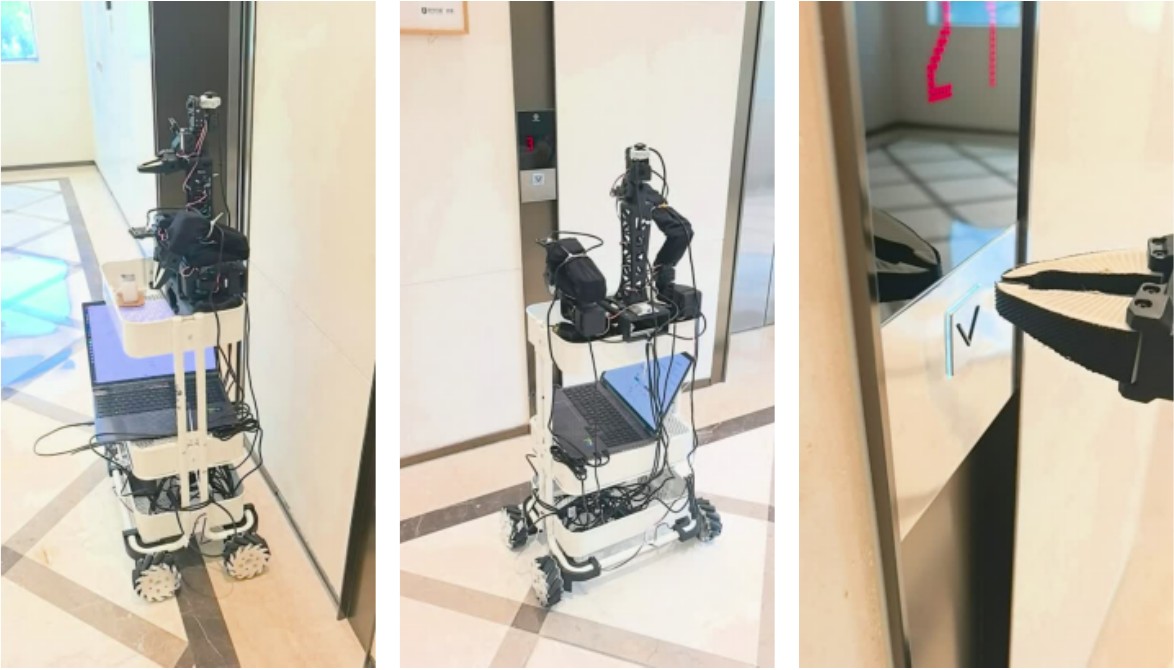
Soon after GPT-6-Astra was released, we quickly launched a study of its potential for robot manipulation. Using XLeRobot, we investigate how descriptions of the robot’s body, records of successful actions, and reusable control programs help with an elevator-button task. Across simulated and physical experiments, body knowledge and prior experience reduce task completion time. We also study visual-feedback skills that emerge during interaction and the reuse of simulation experience on a real robot. These results concern the tested task and starting conditions.
Robot Manipulation with GPT-6-Astra: Body Knowledge, Experience Reuse, Emergent Skills, and Sim2Real Transfer · Preprint, 2026
AI for Science — reconstructing climate from historical archives
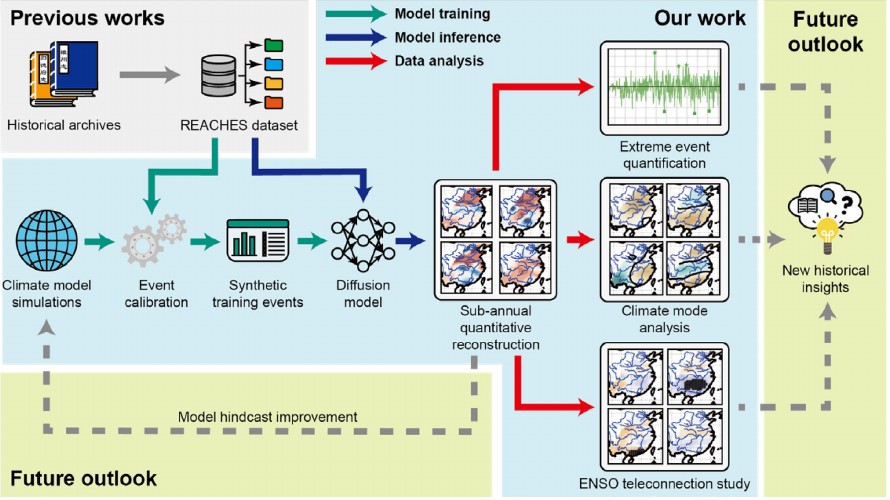
Historical records describe droughts, floods, and other climate events in words, but turning these accounts into quantitative data is difficult. We develop a generative AI framework that infers climate conditions from such descriptions. Applied to Chinese historical archives, it reconstructs precipitation in southeastern China from 1368 to 1911 at sub-annual resolution. The reconstruction captures major droughts and reveals how the influence of El Niño varies across locations and seasons, extending the evidence available for studying past climate variability.
AI Decodes Historical Chinese Archives to Reveal Lost Climate History · Preprint, 2026
CFD applications — indoor airflow and aerosol transport
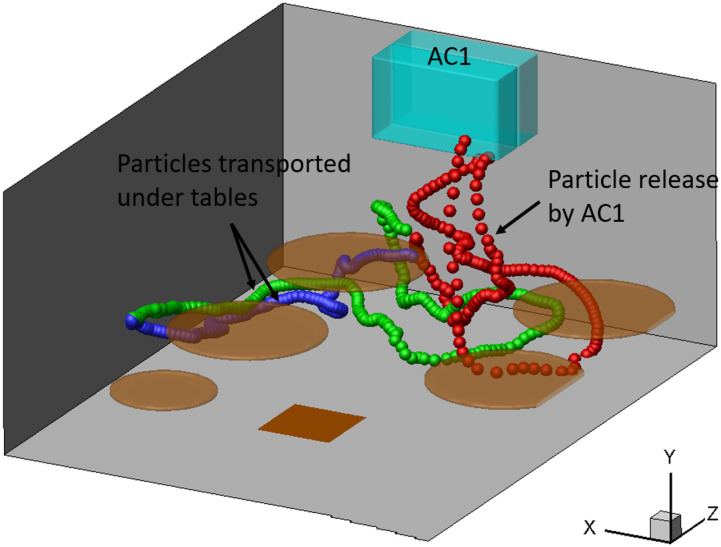
In the early days of the COVID-19 pandemic, we rapidly mobilized our CFD expertise to investigate the urgent question of airborne transmission. We used high-fidelity simulations to study aerosol transport in a restaurant associated with a reported outbreak. Our large-eddy simulations account for turbulence, thermal effects, aerosol motion, and air-conditioner filtration. The resulting exposure maps show a close correspondence between areas of elevated aerosol exposure and the reported infection pattern. Flow analysis and backward tracing of aerosol trajectories help explain how the indoor environment shapes exposure, illustrating the value of detailed flow simulations for assessing airborne transmission in a specific setting.
Simulation-based study of COVID-19 outbreak associated with air-conditioning in a restaurant · Physics of Fluids, 2021
CFD flow physics — turbulence in flexible aquatic canopies
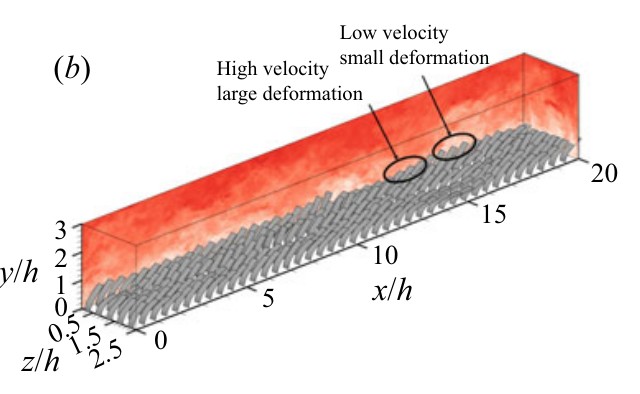
How does the motion of aquatic vegetation change the surrounding turbulence? We combine large-eddy simulation, an immersed boundary method, and a beam model to resolve individual flexible stems and their collective waving. By varying stem flexibility and analyzing energy budgets across scales, we identify how stem motion contributes to turbulent energy transfer. The analysis distinguishes the scales associated with collective waving and individual stem wakes, and explains why very flexible canopies can share flow characteristics with rigid ones.
Simulation-based study of turbulent aquatic canopy flows with flexible stems · Journal of Fluid Mechanics, 2022
CFD algorithms — multiphase fluid–structure interaction
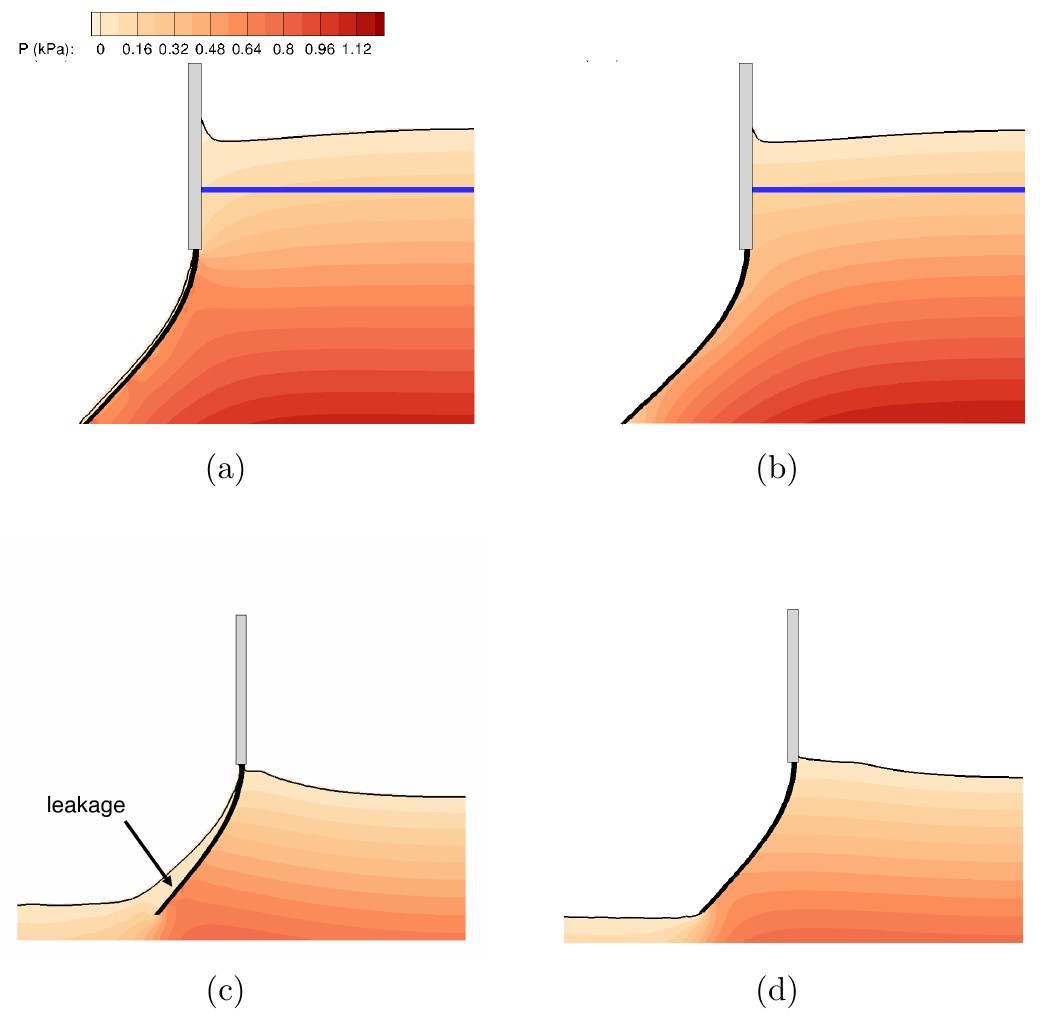
Simulating thin, flexible structures in air–water flows requires accurate treatment of both the moving structure and the fluid interface. We develop an immersed boundary algorithm that reduces artificial flow through thin structures by imposing an explicit pressure boundary condition and revising how computational nodes are classified. The framework combines finite-difference fluid simulation, coupled level-set and volume-of-fluid interface tracking, and finite-element structural deformation. Two benchmark tests show agreement with published results.
Numerical simulation of interaction between multiphase flows and thin flexible structures · Journal of Computational Physics, 2022